Thursday, February 17, 2011

the red queen


okay, when i say parasite, what comes to mind?

ticks?

conjoined parasite twin?


caterpillar hijackers?


scott disick of i-got-kourtney-kardashian-pregnant fame?

well i'll tell you what, when i hear the word parasite, i think of this:


wow, something bird related. weird!

look closely at the above picture, and you'll notice that the bigger bird is getting fed by the smaller bird. what's up with that?

well, this is no episode of "maury: my 10 month old baby is one hundred pounds" or whatever.


yeah that's really not the case here.

instead, something way cooler is happening: brood parasitism! in the above picture, what is portrayed is a young brown-headed cowbird being fed by a yellow warbler.

brown-headed cowbirds are birds in the blackbird family (Icteridae) that live in the great plains of north america, and though they lay their own eggs, they sure as hell don't want to take care of their babies.

i wouldn't either; baby cowbirds are seriously ugly and seriously altricial.


i guess taking care of babies takes a LOT of energy, because you have to provide everything for them, like:

-food
-shelter
-rides to their friends' houses

to save on energy, brood parasites [like cowbirds] have evolved a simple behavior that solves the problem of actually having to raise their own young:

[forced] adoption!

actually, forced adoption is a really nice term for what brood parasites do. Essentially, parasites, like the common cuckoo,

greater honeyguide,


and brown-headed cowbird,

lay their eggs in other species' nests.

this behavior usually translates into some pretty bad things for the host species, including, but not limited to:

1. their own babies dying

but aubrie, why do the host species babies die? can't the introduced young [cowbird, i.e.] and the host young live together happily?

well, simply put...NO

that would be a brown-headed cowbird hogging the bed AND the sheets.

generally, a brood parasites' young hatch earlier and grow at a faster rate than the host's young, and end up out-competing the host babies for food and room in the host nest.

great deal for the baby parasite, bad deal for the host baby.[bad deal like starvation and death]

way short straw deal

the thing about parasite eggs is that they are often hard for hosts to identify as parasite eggs. a lot of the time, birds figure: "well, it's in my nest, musta laid it!" and go on with their lives as if the egg was their own.

and when it hatches, i mean, you have to love your kids no matter what, right?


so, okay, birds aren't going to get rid of eggs they think are their own. and if the parasitic eggs "come to term" as it were, then they're going to get fed and thrive instead of the host species babies.

in fact, to really get the upper hand, the parasites might even get rid of the host eggs themselves:


what lies! what trickery! how treacherous! dang!

yet, there is hope for the hosts.


unfortunately, this hope comes via more baby and egg killin'


as parasites have developed behaviors to lay their eggs in other species' nests, some species have evolved counter-parasite protection plans. for example, the yellow warbler:

when the yellow warbler recognizes there is a foreign egg in its nest, it just builds a new nest to lay eggs in on TOP of the old one.

other birds, like catbirds, just get really angry and throw the eggs outta the nest. sometimes, in their fervor, they actually eject their own eggs out of the nest, too. whoops!


though it provides protection against the invaders, egg recognition and ejection is not the end of this evolutionary battle.

in fact, it is just the beginning.


to prevent host species from recognizing their eggs, cuckoos have developed the ability to lay eggs that look extremely similar to the host's eggs. check it:

the bottom eggs are the impostors. WOW!! that will make it hard to tell.

but aubrie, let's get real. birds can't do stuff like they're in some sort of technological war! they don't even have thumbs or laptop computers.

WRONG! [well, right about the thumbs and laptops bit, maybe] to illustrate and expand your brain, let's have a little evolutionary theory with a side of humiliTEA.


the phenomenon i've been describing to you has often been called an evolutionary arms race, because no matter what one species does to either:

take advantage of [parasite]

-or-

defend themselves [host]

the other will respond [evolutionarily] to keep the status quo.

it's called the red queen effect, after a quote by louis carroll in alice in wonderland.


relatively, though there is evolutionary change in the species, there is no net gain of one species over the other in the given interaction.

woah, thanks leigh van valen! (also, if you're really interested, read this)

graphically, the interactions of host-parasite can be represented with a simple population frequency/generations graph:

more individuals of the host in one generation causes greater success of the next generation of parasites. eloquent!

otherwise, the red queen effect can be represented in terms of fitness.


okay, don't get scared like i do when i see graphs [especially when they're small and black and white. b0ring, i like a little more PiZaZz.]

anyway, all the graph is demonstrating is that:

1. as the adaptiveness of the prey goes up
2. the exploitation of the prey by the predator goes down

basically, it's harder to be a predator when your prey knows all your tricks!

so, the predators eventually learn new tricks.

not quite

for our birds in evolutionary terms:

parasite learns to lay eggs in host nest to save energy--> host bird learns to recognize and eject parasite eggs to save babies --> parasite young ejects host eggs instinctually to out-compete host babies--> ?

looks like it's the host's move to defend...wonder where they'll move the red queen next?!


Tuesday, January 25, 2011

Flowers and Dead Hummingbirds

ok guys, so i found a hummingbird about...oh, four months ago outside of the dining center i frequent on campus. unfortunately, she was dead. the body is currently in my freezer, only venturing out for the occasional party trick and/or webcam photoshoot.

exhibit a:

using my highly developed forensic skills, i have attributed the death to an incident with a window.

my support:

1) i found it in front of a very large, un-smudged window

i don't think you can see it in the photo, but the little tongue is sticking out of its mouth! typical.


okay the picture of the sleeping sloth may or may not be completely unnecessary. i thought things usually died with their tongues out? guess not.

[incidentally, if you are looking for something to do, google image search "dead with tongue out." my safe search is on moderate, and there's still some pretty weird stuff coming up! exciting! [also to note: i do not condone nor condemn turning safe search OFF. i just...know my boundaries.]]

so i couldn't just leave this ickle dead hummingbird with its ickle tongue sticking out on the ground for some janitor or homeless guy to pick up and do lawd knows what with! so, i prepared my forensic kit and carried the body home in my backpack.

here were the contents of my my forensic kit:

1) a napkin from the dining center
2) hand sanitizer

i'm a natural!

my main plan was to dissect ze petit oiseau, but that plan has been put on ice, as school has been in the way of me doing any proper dissections. [pun fully intended, did you catch it? come on i dropped it in your lap. frozen bird? plan on ice?]

plus, apparently, people think it's "weird" and "gross" when you opportunistically dissect animals that are already dead but otherwise in perfect condition.


that's my sister and me with a squirrel that was tragically involved in a hit and run on our street. caught a lot of flack for dissecting that one.

... back to the hummingbird.

so, i had been continuing on with life with a very small, neglected, and dead apodiform in my freezer up until THIS was brought to my attention:

okay, you can't read the caption BUT my friend erin has a hummingbird nesting in her ficus tree! totally exciting! [more about eggs/nests here]

and so my interest in my ickle dead hummingbird with its ickle tongue sticking out has been reinvigorated! thanks erin!

the specific species my hummingbird-cicle is, as you might have guessed, the ruby-throated hummingbird, so named for its...ruby colored throat.

male


female [more about dimorphism here]

i say "as you might have guessed" because the ruby-throated is the only hummingbird native to iowa.

also, i'm going to venture to guess that the hummingbird in erin's ficus tree is an anna's hummingbird:

they're pretty common in SoCal.

as you may have noticed, all of these hummingbirds seem to be hanging out around flowers. lemme tell ya, it's not just because they're both pretty. the birds feed on the sugary substance known as nectar that is produced by the flowers!

i just think it's so perfect that something as cute as a hummingbird would feed on not only sugar, but sugar from flowers. how aesthetically considerate of both parties!

nectar is also popular among other cute animals like butterflies and bumblebees.


the garden above portrays what is known as "buffet-style dining" for nectar enthusiasts.

nectar isn't just sugar water, either, guys. depending on the plant, it can have other essential things for life, such as

1. amino acids [building blocks of proteins]
2. vitamins
3. metal ions [!]
4. proteins

wow! forget acai berries, nectar should be the next big thing!

the only problem is that nectar is rly rly hard to obtain. unless, that is, you have The Proper Equipment!
no, not THAT kind of equipment! speaking of google image search...proper equipment. might want to turn safesearch on for that one.

the nectaries, or the things that actually produce the nectar in a plant, are found at the velly bottom of the flower:
[to note when looking at this diagram:

1. anthers are the parts that produce pollen, pollen being the male bits needed to produce viable seeds [think sperm]

2. pollen from one flower needs to be carried to a different flower's stigma to get to the ovule, the ovule being the female bit needed to produce a viable seed [think egg]]

a probable reason these flowers have their nectaries at the bottom is so hummingbirds and bees and butterflies [and i guess some bats too] have to get all up in the flower to get to the nectar. in the process, these so-called pollinators get covered in pollen, which is then conveniently transported along to the next flower.

comin' atcha!

it follows that the next flower's stigma will get pollen attached to it from the hummingbird, bee, butterfly, et cetera and hopefully an ovule will be fertilized and become a seed!


it's really a win-win situation! i like to think of it as support for the idea of co-evolution.

so, uh, why do we care about flowers? this is supposed to be about birds.

WELL, flowers with nectar at the bottom have determined the morphology of our ickle dead red ruby throated friend, ESPECIALLY with regard to her ickle sticky-outy tongue!

though i speak from limited experience, it's really probably much easier to get to the nectaries at the bottom of a flower if you have a long skinny bill with a loooong skinny tongue.

and guess who has those features?


woodpeckers! ha, gotcha!

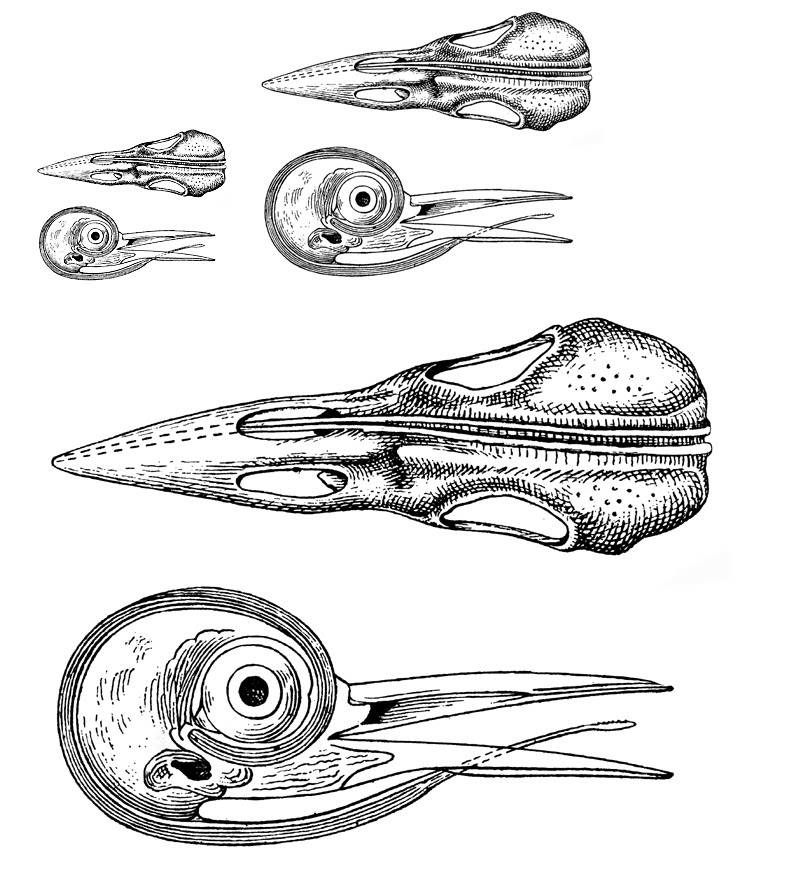
the above is actually a diagram of a woodpecker, but hummingbird tongue morphology follows the same principles.


to reach flowar nectaries, birds can't have a short bill with a short tongue muscle attaching at the base of the trachea. that would be like, i don't know, you trying to drink out of a bud vase. [tongue use only, no cheating!]


don't be foolish, al!

so, hummingbirds [like woodpeckers] have specialized structural features of their skull that allow for housing a long tongue. here's a picture of the skull:


see that forked thingy? that's the tongue tract that eventually leads to the throat. it also just so happens to be The Proper Equipment to get dat nectar, allowing for the win-win interactions of flowers and hummingbirds. unless, of course, they're dead.


mmm, sugar water.

Thursday, July 29, 2010

The Jacana

well, I'll tell you what, I went to Les Grands Tetons avec my family and friend for vacation last week.

and i'll tell you what else, it was beyond beautiful.

[follow standard magic eye procedure and you'll see me. i'm on the right!]

i was really frustrated at first when we got there, because the birds were not iowa natives. i could not recognize hardly any of them! it was so annoying to see this guy:

and not have a clue as to who he was! i felt like such an ornithological fraud. don't worry, i didn't go into a state of depressed self re-evaluation wherein i decided to completely give up birding.

i just got a book for species ID!

turns out that black and white dude is a magpie. the bird on the front of the book is a male western tanager, which i saw flitting around camp more than once. his colors are so wild!

also at camp was a fellow birder! she works for hawkwatch,and it was great to hang around and geek out about birds with her. she had a sibley guide, which made me jealous. naturally, i had to get one so i didn't have to keep coveting hers! [and one about behavior. thanks mom and dad!]

my dad totally got mad at me for my instant gratification reflex. i blame society and say it's a symptom of not only me but my whole generation to want things RIGHT NOW. so gimme dat book!

i figure it is now up to me to:
a) wolf down the information in these books as fast as i can and then
b) relay it back in fun and easily digestible blog-o-form to you, the reader!

weird, it's kind of like when a mother bird regurgitates food into her young's gullets. happy analogy! but kinda gross!

while i was perusing these new books of mine for information about grouse mating rituals, i stumbled upon these guys:

jacanas! not grouse, but not bad! they're in a family known as jacanidae, and in the same order as killdeer [charadriformes].

the family is comprised of six species, all of which are characterized by what first caught my eye: the foot morphology.

jacanas, being shorebirds, have "amazingly long toes" adapted for smooth commute on top of floating vegetation.


holy phalanges, that thing can walk on lily pads!

my favorite, aesthetically speaking, is the comb crested jacana. also known as lilytrotters, comb crested jacanas are cool because they have those weird bright red combs on their foreheads; it's almost as if walking on water hyacinth wasn't impressive enough.

one might think: well, the comb must be for the males to attract the ladies. TyPiCaL~*

and one would be right! kind of!

BUT jacanas are an interesting set of birds: they are polyandrous.

as you may have guessed from the above stock photo, polyandrous implies "a lot of guys serving one girl." but i can break it down even further for you with my rudimentary understanding of greek! as i understand it, polygamy is multiple partners; polygyny multiple females to one male.

poly = many
gamy = any reproductively active bits
andry = male reproductively active bits
gyny = female reproductively active bits

polyandry, then, must be the opposite of polygyny!

with jacanas, the females mate with a male, lay the eggs, and leave the male to take care of the fertilized eggs. the female then mates with a different male and pulls the same stunt: she lays and leaves. no time for actually tending to the young--leave that to the male.

hey honey, can you take care of the nest? i'm going to be late tonight.

see yuhh

jacana females are, on average, much larger than the males, and seem to be the dominant [in the territorial sense] sex. according to the PBS online library, the reason behind the jacana's polyandry may be due to the high amount of egg predation the species of the jacanidae family has historically experienced. due to predatory conditions, if the females lay more eggs, the species has a higher survival rate. jacana females have evolved to become "egg laying machines"

and i mean, let's be honest, those eggs look SWEET. i would totally prey on those babies. [pun fully intended]